Fast shipping from the USA

Gaggia Classic Pro & E24 Review: Why the Gaggia Classic Is Still One of the Best Home Espresso Machines
A practical review of the Gaggia Classic Pro and E24, covering build quality, temperature stability, steaming, workflow, upgrade potential, and why the Gaggia Classic remains a popular choice for home espresso.
January 06,2026
If you’ve been researching espresso machines for any length of time, you’ve probably come across the Gaggia Classic.
There is a good reason for that.
While newer espresso machines often arrive with touchscreens, automatic dosing, digital temperature controls, and dozens of settings, the Gaggia Classic has stayed surprisingly simple. It is essentially a compact, traditional espresso machine built around a boiler, pump, commercial-style group, steam wand, and physical switches.
And somehow, that simplicity has become one of its biggest strengths.
The Gaggia Classic Pro helped modernize the Classic platform while keeping the basic design that made the original so popular. The newer Gaggia Classic Pro E24 takes another meaningful step forward with a lead-free brass boiler and brass group while retaining the familiar 58 mm espresso platform. Gaggia currently lists the E24 with a single 3.5 oz brass boiler, 9-bar OPV calibration, commercial-style two-hole steam wand, 72 oz water reservoir, and 58 mm stainless-steel portafilter.
But specifications don’t completely explain why so many home espresso enthusiasts choose the Gaggia Classic.
The bigger story is what the machine can become.
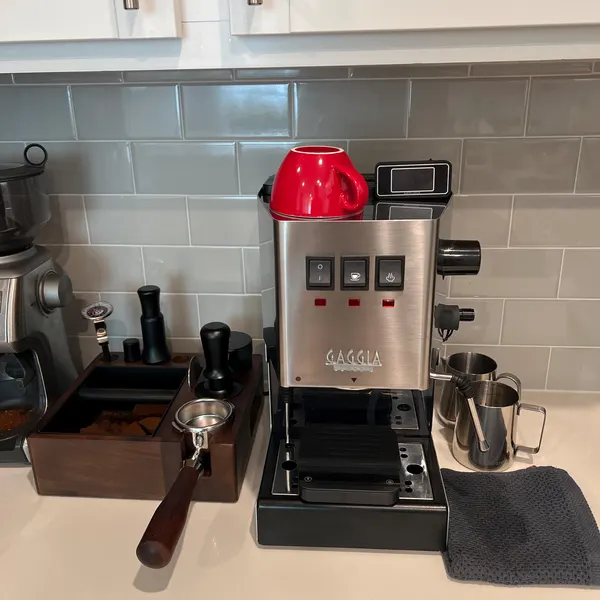
Quick Verdict
Gaggia Classic Pro
The Gaggia Classic Pro remains an excellent choice for someone who wants to learn traditional espresso preparation without spending prosumer-machine money.
It gives you the fundamentals of a serious espresso setup:
- 58 mm brewing platform
- Three-way solenoid valve
- Commercial-style steam wand
- Rugged metal construction
- Replaceable and serviceable components
- Huge selection of accessories and upgrades
Its biggest weakness is temperature control. The stock machine relies on thermostats rather than precise electronic temperature regulation, meaning experienced users often learn techniques such as temperature surfing to improve shot-to-shot consistency.
That weakness, however, is also one reason the Classic developed such a large modification community.
Gaggia Classic Pro E24
If you’re buying a new traditional Gaggia Classic today, the E24 is the model we would choose.
The most important change is the new lead-free brass boiler. Gaggia says the brass construction improves thermal stability and steaming performance. It is paired with a solid brass group and stainless-steel portafilter.
The basic character of the machine hasn’t changed and that’s a good thing.
It is still compact, mechanical, repairable, and extremely upgradeable.
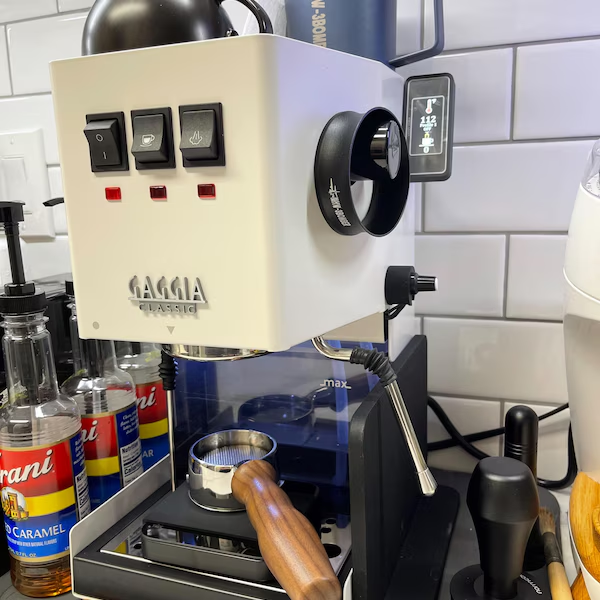
The Gaggia Classic’s Secret Weapon: Upgrades
This is where the Classic separates itself from many competing espresso machines.
You can buy one, use it completely stock, and make good espresso.
But you don’t necessarily have to leave it that way.
There is an enormous aftermarket ecosystem for the platform.
Common upgrades include:
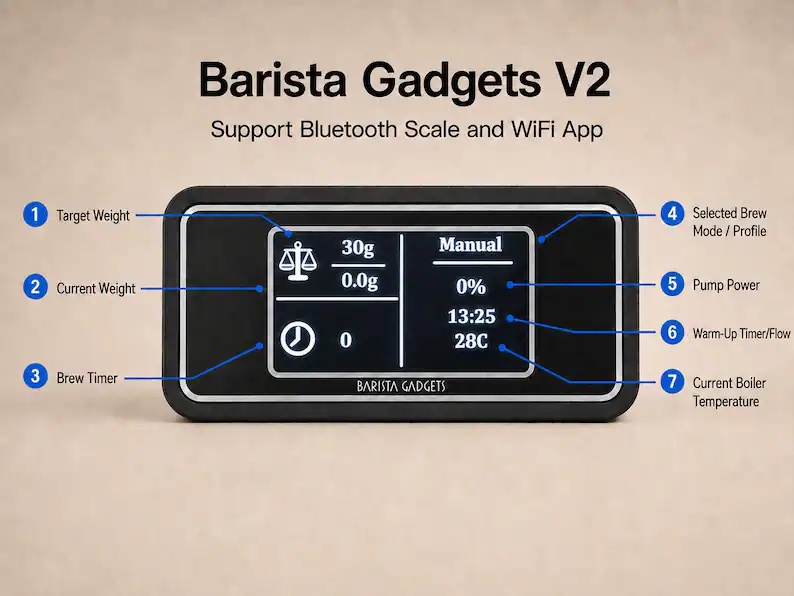
PID temperature control, pressure monitoring, pump-power control, flow control systems, upgraded steam tips, precision baskets, bottomless portafilters, low-profile drip trays, upgraded shower screens, scales, and much more.
Who Should Buy the Gaggia Classic Pro E24?
We would strongly consider it if you:
enjoy learning how espresso works, want a machine that can be repaired rather than discarded, plan to upgrade your setup gradually, want access to standard 58 mm accessories, prefer physical controls over appliance-style automation, or simply want a strong espresso platform without moving immediately into expensive prosumer machines.